
SELF-PACED · LIFETIME ACCESS
The Diagnostic
Course.
Framework
For home-based makers using handheld torches who are tired of guessing — and want to finally understand the 'why' behind what's going wrong.
£67
SELF-PACED· LIFETIME ACCESS · INSTANT START
You follow every
instruction correctly.
And still fail.
The tutorials say "heat evenly." They don't say how to know when you've done it. The instructions say "apply flux." They don't say what good flux behaviour looks like — or what bad looks like.
The problem isn't your technique. It's that nobody has ever shown you how to read what's happening in real time.
Sound familiar?
Solder that balls up instead of flowing
Joins that look fine but fall apart
Flux that burns before the solder moves
Pieces that overheat no matter what you do
Results that are different every single time
"I was following every instruction perfectly. Linda showed me I'd been misreading the signals the whole time."
WHAT YOU'LL LEARN
One framework. Four modules.
No more guessing.

Every successful join is governed by five environmental factors. This module shows you how to audit your setup before you ever touch the torch.
01
The Five Conditions
WHAT WE COVER
The Physics of Flux: Timing, placement, and volume.
The Geometry of Fit: Why the gap dictates the flow.
Surface Prep: Identifying "invisible" contaminants.
Stop relying on timers or "even heating." Learn to use the metal’s physical changes as a live temperature guide.
02
Reading Heat in Real Time
WHAT WE COVER
The Colour Scale: From cold silver to the "glow" of flow.
The Bite Point: Identifying the exact second solder is ready.
Torch Position: Using distance as a precision throttle.


03
Flux and Solder as Signals
Learn to interpret how your consumables behave. Their movement and state are live feedback, telling you what you can’t see with your eyes alone.
WHAT WE COVER
Flux as a Thermometer: Reading the state of active flux.
Solder’s Path: Understanding how surface tension guides the flow.
Predictive Setup: Using signal history to predict the next joint’s behavior.
04
The Diagnostic Framework
Everything comes together in a repeatable system you can apply to any joint. The pre-flight checklist that changes how you approach the bench.
WHAT WE COVER
The 3 Crucial Questions: What to ask before you ever light the torch.
Root Cause Analysis: Tracing failure back to its source.
The 3 Crucial Questions: What to ask before you ever light the torch.
What real diagnostic
soldering looks like.
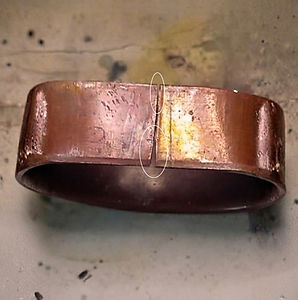


01 | The Gap (The Signal)
02 | The Flush Join (The Prep)
03 | The Flow (The Execution)
04 | The Polish (The Result)
What it looks like when it all clicks.
These are real messages from Annette, a student on the 6-week beta programme. Not edited. Not polished. Just what happens when a maker stops guessing and starts reading the signals.
It has stopped being a matter of good luck now.
"I actually understand what I’m looking at when I’m at the bench. I think it is just a matter of practice—I somehow put unequal pressure on the file itself, ending up with a small curve... but now I know exactly what to do differently next time. That is the shift: from guessing to diagnosing.
ANNETTE H
"After working with Linda, my soldering changed dramatically. She pinpointed the problem straight away."
RACHEL T.
"What I thought 'heating the pieces evenly' meant was completely different to what it actually requires."
JEANETTE S
READY TO STOP GUESSING?
The framework.
The signals.
The shift.
"I actually understand what I'm looking at when I'm at the bench. It has stopped being a matter of good luck."
Self-paced, lifetime access. For home-based makers using handheld torches who are tired of guessing.
£67
SELF-PACED · LIFETIME ACCESS · INSTANT START